


GREAT Scholarships 2026–27 for Masters for Pakistani Students

Studying in the UK is a dream for many Pakistani students, but high tuition fees often make it difficult. The good news is that the British Council’s GREAT Scholarships offer a great opportunity to reduce this financial burden and study at some of the top universities in the UK.

The British Council offers scholarships to Pakistani students as part of its broader mission to promote high-quality education and strengthen academic links between Pakistan and the United Kingdom. These scholarships aim to provide talented students with access to UK universities while encouraging educational development, cultural exchange, and global collaboration.

Beyond academic support, such initiatives also serve as a strategic effort to build long-term relationships, develop future leaders, and foster mutual understanding between the two countries. By supporting Pakistani students, the British Council contributes to skill development, knowledge transfer, and the promotion of shared educational values in an increasingly interconnected world.

For the 2026–27 academic year, many well-known UK universities are offering GREAT Scholarships worth £10,000 or more for Pakistani students. In this blog, we explain everything in simple English — who can apply, which universities are offering scholarships, IELTS requirements, fees, and how to apply.

What Is the GREAT Scholarship?

The GREAT Scholarship is a funding program supported by the British Council and UK universities. It helps Pakistani students to study one-year taught master’s degrees in the UK. This scholarship will be paid to postgraduate students in terms of tuition fees discount worth £10,000 – £15,000.

How Much Are UK Master’s Fees?

UK master’s tuition fees usually range between £15,000 to £40,000 per year, here is the calculation for estimated fees and its discount offer.

  • For example tuition is fee: £22,000
  • GREAT Scholarship: £10,000
  • Student pays remaining: £12,000

Note: The scholarship reduces the fee, but it does not cover living expenses, visa fees, or travel costs.

Universities Offering this Scholarship

UK universities offering GREAT Scholarships to students from Pakistan:

  • University College London (UCL)
  • Cardiff University
  • City St George’s, University of London
  • Keele University
  • Northumbria University
  • Robert Gordon University
  • SOAS University of London
  • University College Birmingham
  • University of Bath (excluding MBA)
  • University of Glasgow
  • University of Leicester
  • University of Portsmouth (selected Humanities & Social Sciences programs)
  • University of Manchester (for selected taught master’s programmes)

Reference:

https://study-uk.britishcouncil.org/scholarships-funding/great-scholarships/pakistan

Who Can Apply for GREAT Scholarships?

To apply for this scholarship, applicant should be Pakistani passport holder and resident with completed bachelor’s degree. Candidate must meet minimum criteria and be motivated and interested in subject he is applying for.Which Courses Are Covered?

Most universities offer GREAT Scholarships for:

*  Business and Management             *  Computer Science and IT

*  Engineering                                      *  Data Science

*  Social Sciences                                *  Education

*  International Relations                     *  Cyber Security and Digital Fields

How to Apply for this Scholarship

Following is the step by step to apply for this scholarship

  1. Prepare Your Documents

Before you start your application, gather the following:

  • Academic transcripts
  • Degree certificates
  • CV/Resume
  • Personal statement / Statement of purpose
  • English language test results (IELTS/TOEFL or equivalent)
  • References / Recommendation letters
  • Passport copy
  • IELTS Score (most of universities require IELTS 6.0 to 6.5 score)
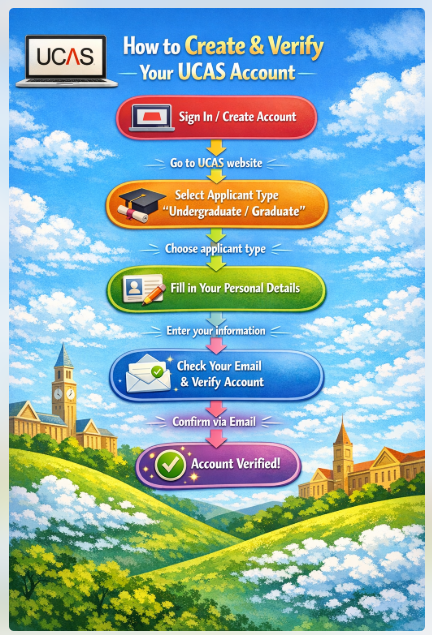
  1. Create a UCAS Account

Go to https://www.ucas.com/


Click Sign in / Create account


Choose the correct applicant type (usually Undergraduate / Graduate – depending on course)


Fill in your personal details


Confirm and verify your UCAS account via email


Note: UCAS is mainly used for many UK postgraduate applications, but check if the specific university accepts UCAS applications for that Master’s programme. Some universities have direct online portals for admission.

  1. Start your UCAS Application

  • Log in to your UCAS Dashboard
  • Click Start a new application
  • Search and select your intended Master’s Degree programme at the chosen UK university
  • Add detailed academic history and personal information
  • Upload required documents
  1. Write a Strong Personal Statement

  • Explain why you want to study the chosen programme
  • Highlight academic strengths, work experience (if any), and future goals
  • Mention your interest in the GREAT Scholarship if relevant
  1. Submit References

  • Provide academic or professional referees’ contact details
  • UCAS will send requests to your referees for recommendation letters
  1. Apply for the Scholarship (If Required Separate from University Application)

Some universities require a separate scholarship application after your programme application. If so:

  • Follow the university’s scholarship application portal instructions
  • Use your UCAS application details if asked
  • Submit any additional essays or forms required for the GREAT Scholarship
  1. Pay Application Fees (if any)

  • Some universities may charge an application fee
  • Complete payment to ensure your application is processed
  1. Submit Your Application

  • Double-check all sections
  • Submit your UCAS form before deadlines
  • Keep track of a confirmation email
  1. Track Application & Wait for Offers

  • UCAS Track lets you monitor offers from universities
  • You may receive:
  • Unconditional offer
  • Conditional offer (based on qualifications)
  • Rejection

If you get an offer, follow the instructions to accept it on UCAS

  1. Scholarship Outcome

Once your university confirms your place:

  • The university will notify you if you are awarded the GREAT Scholarship
  • Scholarship amount (e.g., £10,000 — up to £15,000) is usually credited toward tuition fees
  • You will receive details on how the discount is applied

University Deadline

*  UCL                                                  *  07th May 2026

*  Cardiff University                              *  31th May 2026

*  University of Leicester                      *  31th May 2026

*  Most other UK institutions                 *  April – June 2026 (varies)

Note: Final overall deadline for scholarship awards By  30 June 2026.

Conclusion

The GREAT Scholarships 2026–27 are an excellent opportunity for Pakistani students who want to study in the UK but need financial support. With £10,000–£15,000 funding, world-class universities, and global exposure, this scholarship can be a life-changing step.

If you are planning to study abroad, start preparing early:

  • Improve your English
  • Shortlist universities
  • Prepare your documents
  • Apply on time
U.S. Immigration Policy Tightens Focus on Financial Self-Sufficiency

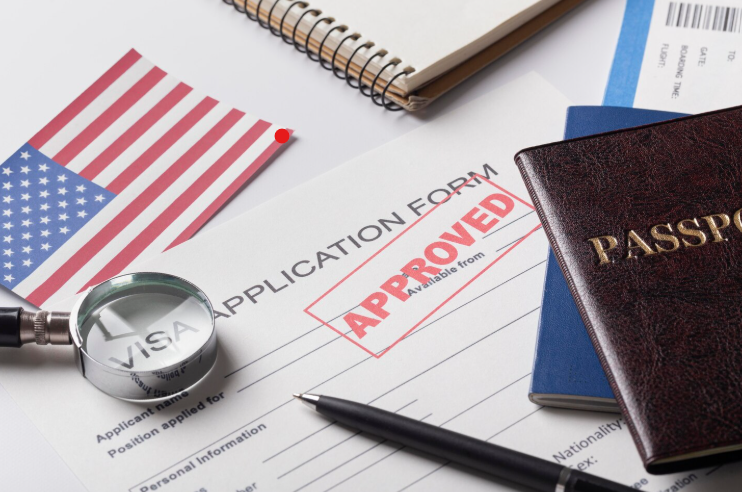
The United States has reinforced its immigration screening process with a strong emphasis on financial self-sufficiency. Under the updated approach, immigrants must demonstrate that they will not become a financial burden on American taxpayers or rely on public welfare programs.

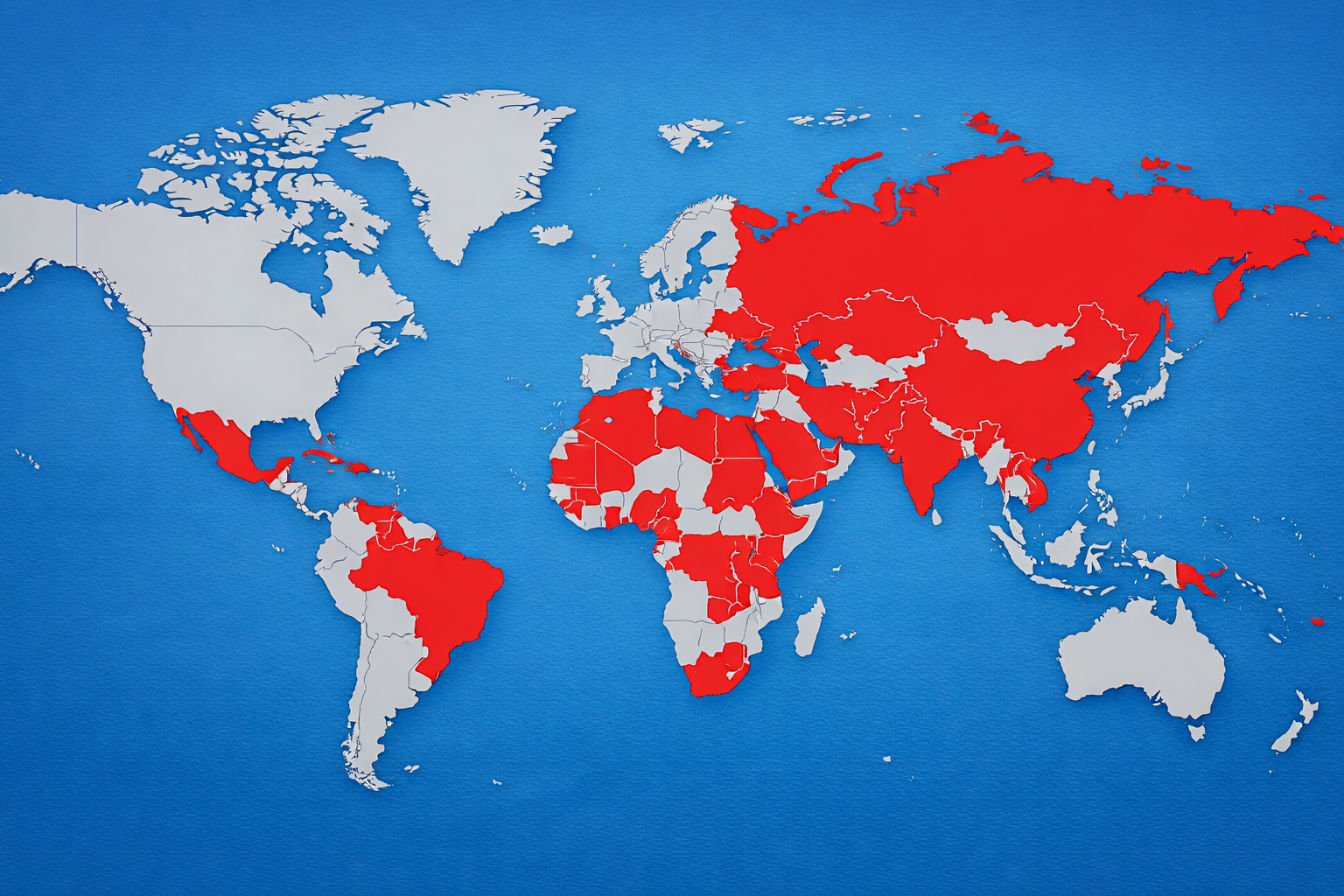
As part of this policy, applicants from certain countries are classified as high-risk, and visa issuance for these countries has been paused indefinitely. The decision is linked to concerns over visa fraud, overstays, misuse of public benefits, and other immigration-related violations.

Background and Reported Reasons for the Ban

According to data from the U.S. State Department, immigrants from parts of Central Asia and the Caucasus—including Kazakhstan, Uzbekistan, Kyrgyzstan, and Georgia—have been linked to a growing number of immigration violations. These include visa fraud, overstays, misuse of public assistance programs, human smuggling schemes, labor trafficking, and the submission of forged or fraudulent documents.

Several high-profile incidents have further strengthened the case for stricter controls. These include the killing of two National Guard members by an Afghan national and a major fraud scandal in Minnesota involving the misuse of taxpayer-funded benefit programs by Somali nationals or Somali-Americans. Such incidents reportedly influenced former President Donald Trump’s decision to impose the ban and advocate for long-term restrictions on immigration from certain developing countries.

Countries Classified as High-Risk (Visa Issuance Paused)

COUNTRIES CLASSIFIED AS HIGH-RISK (VISA ISSUANCE PAUSED)

Afghanistan, Albania, Algeria, Antigua and Barbuda, Armenia, Azerbaijan, Bahamas, Bangladesh, Barbados, Belarus, Belize, Bhutan, Bosnia and Herzegovina, Brazil, Burma (Myanmar), Cambodia, Cameroon, Cape Verde, Colombia, Côte d’Ivoire, Cuba, Democratic Republic of the Congo, Dominica, Egypt, Eritrea, Ethiopia, Fiji, The Gambia, Georgia, Ghana, Grenada, Guatemala, Guinea, Haiti, Iran, Iraq, Jamaica, Jordan, Kazakhstan, Kosovo, Kuwait, Kyrgyz Republic, Laos, Lebanon, Liberia, Libya, Moldova, Mongolia, Montenegro, Morocco, Nepal, Nicaragua, Nigeria, North Macedonia, Pakistan, Republic of the Congo, Russia, Rwanda, Saint Kitts and Nevis, Saint Lucia, Saint Vincent and the Grenadines, Senegal, Sierra Leone, Somalia, South Sudan, Sudan, Syria, Tanzania, Thailand, Togo, Tunisia, Uganda, Uruguay, Uzbekistan, and Yemen

Countries Not Considered High-Risk (Visas Issued as Usual)

Andorra, Angola, Argentina, Australia, Austria, Bahrain, Belgium, Benin, Bolivia, Botswana, Brunei, Bulgaria, Burkina Faso, Burundi, Canada, Central African Republic, Chad, Chile, China, Comoros, Costa Rica, Croatia, Cyprus, Czech Republic, Denmark, Djibouti, Dominican Republic, Ecuador, El Salvador, Equatorial Guinea, Estonia, Eswatini, Finland, France, Gabon, Germany, Greece, Guyana, Honduras, Hungary, Iceland, India, Indonesia, Ireland, Israel, Italy, Japan, Kenya, Kiribati, North Korea, South Korea, Latvia, Liechtenstein, Lithuania, Luxembourg, Madagascar, Malawi, Malaysia, Maldives, Mali, Malta, Marshall Islands, Mauritania, Mauritius, Mexico, Micronesia, Monaco, Mozambique, Namibia, Nauru, Netherlands, New Zealand, Norway, Palau, Panama, Papua New Guinea, Paraguay, Peru, Philippines, Poland, Portugal, Qatar, Romania, Samoa, San Marino, São Tomé and Príncipe, Saudi Arabia, Serbia, Seychelles, Singapore, Slovakia, Slovenia, Solomon Islands, South Africa, Spain, Sri Lanka, Suriname, Sweden, Switzerland, Tajikistan, Timor-Leste, Tonga, Trinidad and Tobago, Turkey, Turkmenistan, Tuvalu, Ukraine, United Arab Emirates, United Kingdom, United States, Vanuatu, Vatican City, Venezuela, Vietnam, Zambia, and Zimbabwe

Visa Categories Currently Suspended

The visa categories as mentioned below will remain suspended from 21st January 2026, This suspension is intended to allow immigration authorities to reassess applications more thoroughly, with particular focus on financial self-sufficiency, employment prospects, and the likelihood of long-term reliance on public resources. During this period, new approvals under the affected categories are on hold, while previously submitted cases may be subject to enhanced scrutiny before any further action is taken.

  • EB-1 (priority workers)
  • EB-2 (advanced degree / exceptional ability)
  • EB-3 (skilled workers & professionals)
  • EB-4 (special immigrants)
  • EB-5(investor)

Visa Categories That Remain Open

Despite the suspension of certain immigrant visa categories, the United States continues to issue several non-immigrant and special-purpose visas without interruption. Applicants under these categories are still processed through standard procedures, although they remain subject to routine background checks, eligibility requirements, and admissibility reviews.

  • H-1B
  • L-1
  • O-1
  • B-1
  • B-2
  • F-1
  • M-1
  • Diversity Visa
  • and other non-listed categories.

How Cases Will Be Reassessed

Immigration cases will now be re-evaluated using stricter criteria, with a strong focus on financial stability, health, employability, and long-term risk.

  1. Financial Assessment

Authorities will review:

  • Bank statements, including balance history, consistency, and source of funds
  • Sudden or unexplained deposits, which are treated as red flags
  • Income versus expenses
  • Stability and continuity of earnings
  • Affidavits of Support, where applicable
  • Property ownership, investments, and savings
  • Outstanding debts or loans


Note: Applicants with stable income, savings, and accessible assets are considered stronger candidates, while those with heavy debt or weak financial history face a higher risk of refusal.

  1. Age Considerations
  • Very young applicants are assessed for employability and future job prospects.
  • Older applicants are evaluated for healthcare needs and potential retirement-related dependency.

Note: Age alone will not determine the approval or refusal of any immigration case.

  1. English Proficiency

English language ability is assessed during interviews and through educational history, including the medium of instruction used at universities. The goal is to determine the applicant’s ability to integrate and avoid dependency.

  1. Medical and Health Evaluation
  • Mandatory medical examinations are conducted by panel physicians
  • Chronic illnesses requiring long-term or institutional care may result in refusal
  • Applicants must demonstrate the ability to pay for medical treatment and insurance


For example, a diabetic applicant with strong financial resources is considered low risk, while one without savings or insurance is viewed as high risk.

  1. Employment Prospects
  • Work history, education, and job market demand are key evaluation factors
  • EB-1 and EB-2 professionals are generally viewed as strong candidates
  • Applicants with prior job offers have a higher chance of approval
  • High-demand fields such as healthcare, academia, and STEM are favored

Legal Framework Used for Evaluation

Cases are assessed under established government manuals and legal frameworks, including:

  • Foreign Affairs Manual (FAM 302.8)
  • USCIS Policy Manual (Volume 8)
  • Internal State Department cables and memoranda

Relevant case law interpretations

History and Expected Time of Lifting of the Ban

Historical Precedents and Similar Restrictions

Similar travel and visa restrictions were imposed between 2017-2020 under the Trump administration. Countries affected included Iran, Iraq, Libya, Somalia, Sudan, Syria, Yemen, North Korea, and Venezuela. Partial visa pauses and heightened screening were also applied to Eritrea, Kyrgyzstan, Myanmar, Nigeria, Tanzania, and Sudan.

Between 20182020, a large number of immigrant visa applications from Bangladesh, Pakistan, Nepal, Haiti, Guatemala, Honduras, and El Salvador were refused due to low income levels, weak employment prospects, and a high likelihood of reliance on public assistance.

The longest comparable restriction lasted nearly four years. Based on past patterns, if reassessments move quickly, the current pause could be lifted within three to four months. However, if public-charge screening is prioritized over processing speed, the pause could extend for two to four years. Political changes or a new administration could lead to a faster reversal.

More than 200 individuals have reportedly filed lawsuits against the Trump administration challenging the nationality-based restrictions. In a federal court in Boston, plaintiffs argue that the suspension is unlawful and that immigration authorities cannot freeze adjudications for individuals already residing in the United States.

According to media reports, students, researchers, technologists, and other professionals are living in prolonged uncertainty and are urging the government to lift the pause and comply with existing immigration laws.

On other hand, Government officials have stated that pending applications are being reviewed to identify high-risk profiles, after which strict action will be taken. Only applicants deemed low risk are expected to proceed under the revised screening process.

Current Legal Developments

Several developments could force U.S. authorities to lift the current visa pause sooner than expected.

First, the growing backlog of immigration cases poses a serious challenge to the overall immigration system. Prolonged delays risk overwhelming USCIS and the State Department, making it difficult to manage existing and future applications efficiently. For this reason, the suspension cannot realistically continue for an extended period without disrupting the immigration process.

Second, immigration advocacy groups and legal organizations are likely to challenge prolonged nationality-based restrictions. Extended bans based on country of origin face strong legal scrutiny and may be contested as inconsistent with existing immigration laws and principles of equal treatment.

Third, continued delays may become a political issue, providing opposition parties with an opportunity to criticize the administration’s immigration policies. A shift in political power or leadership could significantly increase the chances of the suspension being lifted earlier than anticipated.

Conclusion

Immigration authorities will continue reassessing cases based on financial stability, health, employability, and long-term dependency risks. The duration of this pause depends on legal outcomes, political developments, and administrative priorities.


Getting Your Degree Verified from the University of Sindh

If you are looking to get your educational documents such as your degree, transcript, marksheet, or any other document—verified by the University of Sindh, please follow the steps below.

Step 1: Confirm Your Student Type

First, confirm whether you studied at the university as a regular student or through an affiliated college.

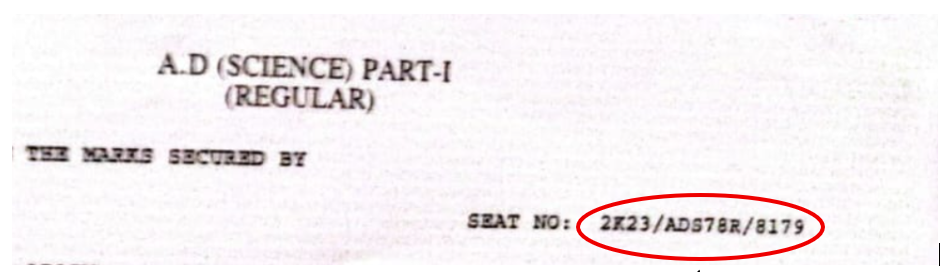
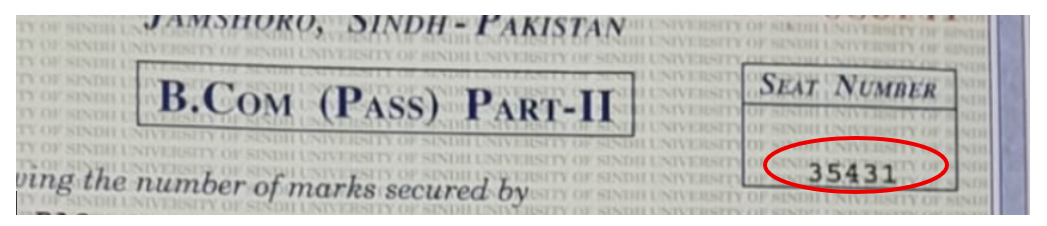
Tip: – University regular students usually have seat/roll numbers like 2K19/ITE/52. Affiliated college students usually have seat/roll numbers like 2K25/COM-47/38, 2K23/ADS78R/8179, or 35431, as shown in the figures below.

Figure 1: Snapshot showing an affiliated college seat/roll number

Figure 2: Snapshot showing an affiliated college seat/roll number

Step 2: Generating the Verification Fee Challan / Voucher

2.1 For University Regular Students

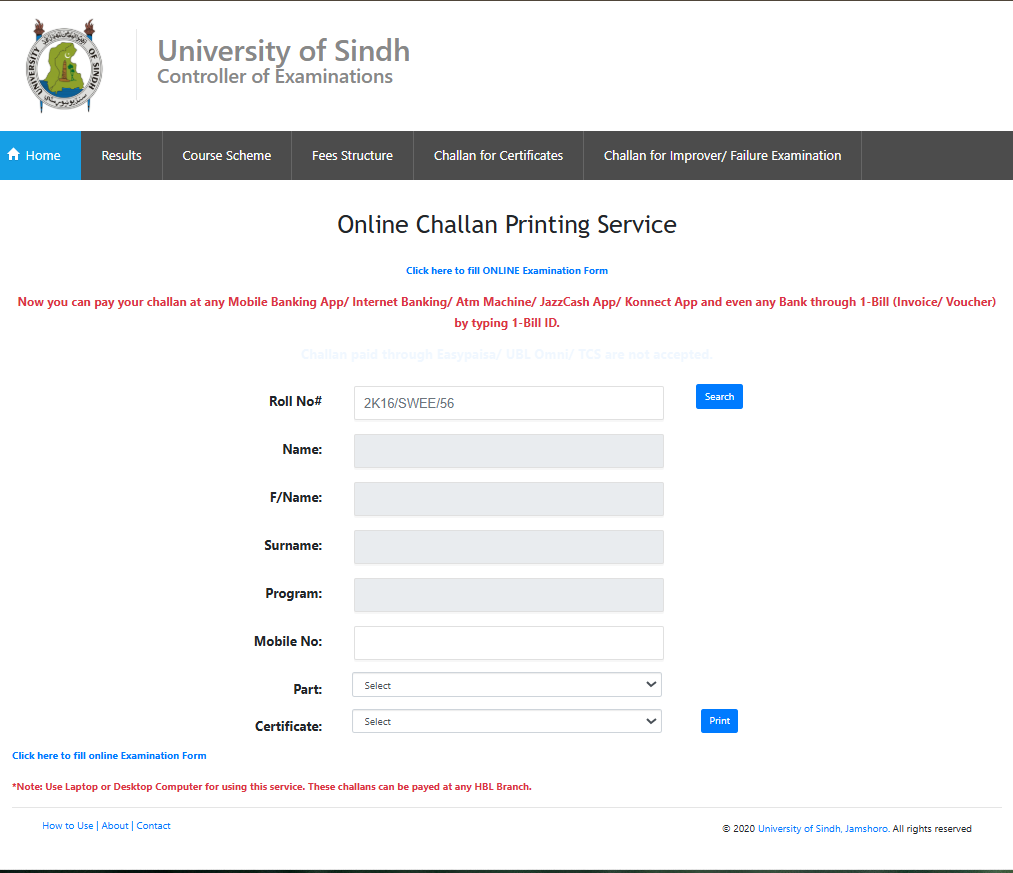
Visit the following portal: https://exam.usindh.edu.pk/, as shown in the figure below.

Figure 3: Snapshot showing the Certificate Challan Printing Service page

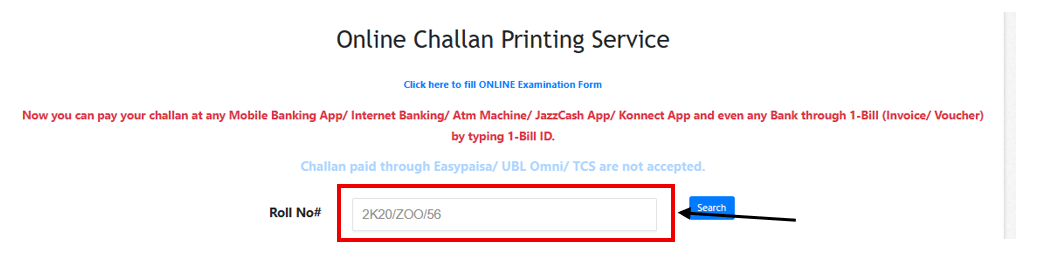
Search your seat/roll number in the Roll No# field, as shown in the figure below. Your record will be searched, and fields such as Name, Father’s Name, Surname, and Program will be filled automatically.

If you are unable to find your record, check your examination slip or previously issued marksheet to confirm the correct roll number. Make sure you are entering the correct seat/roll number.

Figure 4: Snapshot showing the record search field

Tip: If your record still does not appear, it means it has not been updated in the university’s online portal. If you continue to face the issue of “Record Not Found,” contact the University’s Directorate of IT (ITSC) at info@usindh.edu.pk.

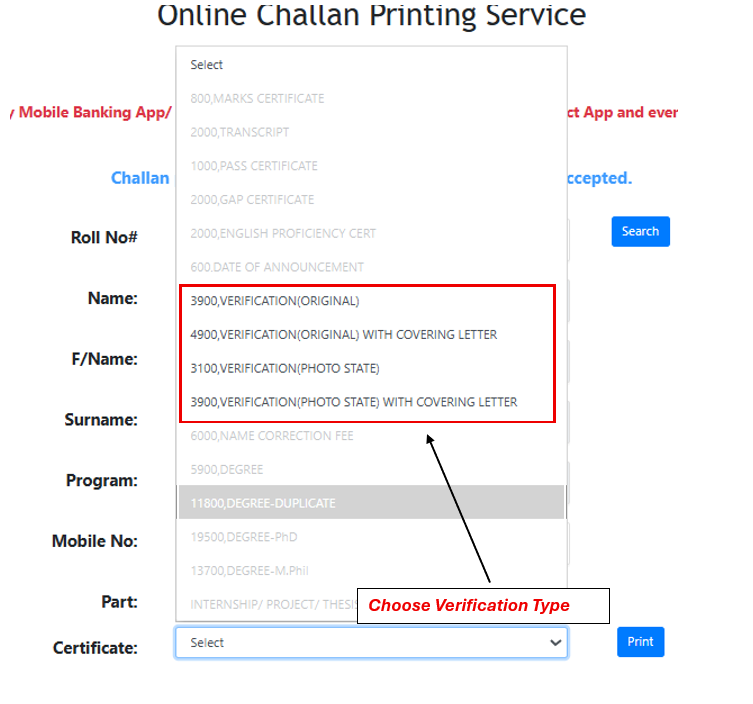
Once your record is found, select the required certificate from the dropdown list, as shown below.

Figure 5: Snapshot showing various types of verification challans/vouchers

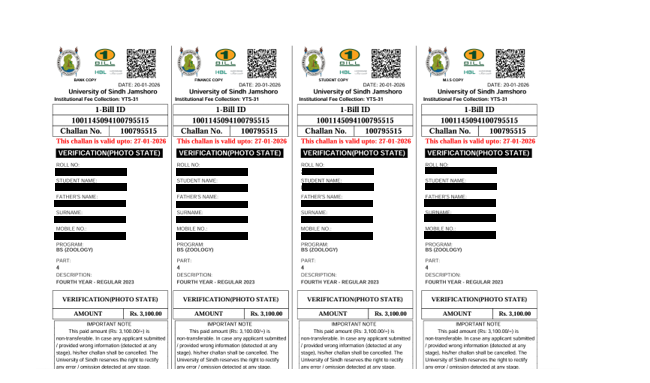
After selecting the desired certificate and entering the required details (mobile number and part), click the “Print” button to generate the fee challan/voucher. The generated challan/voucher can be paid through the 1Bill channel only.

Tip: Pay this challan/voucher only through an app or banking channel that supports the 1Bill service.

     Figure 6: Snapshot showing the Certificate Fee Challan / Voucher

Types of Verification Challans (University Regular Students)

There are four types of verification challans/vouchers, each with a different fee and purpose:

1. Verification (Original)
  • Fee: PKR 3,900
  • Used to verify original certificates.
  • Submit the original certificate to the Controller of Examinations (Semester) Office along with the paid receipt and a printed copy of the challan/voucher.
  • If paid at a bank counter, a bank stamp is required on the printed challan.
  • The verified certificate is usually returned the same day after 2:00 PM if submitted early in the morning.
  • The verifying authority signs and stamps the back of the original certificate.

Tip: You can check the challan payment status at: https://itsc.usindh.edu.pk/eportal/public/verify_challan.php

2. Verification (Original) with Cover Letter
  • Fee: PKR 4,900
  • Includes verification of the original certificate along with a confirmation cover letter.
  • Submission and return process is the same as above.
3. Verification (Photocopy)
  • Fee: PKR 3,100
  • Used to verify photocopies of certificates.
  • Submit the photocopy along with the paid receipt and printed challan.
  • The verified photocopy is returned the same day after 2:00 PM if submitted early.
4. Verification (Photocopy) with Cover Letter
  • Fee: PKR 3,900
  • Includes verification of photocopies along with a cover letter.
  • The cover letter can be addressed to any organization, firm, person, or educational institution upon request.

Additional Tips: – The university can email verified documents with a cover letter to the requesting organization upon request. – Verified documents can also be sent via courier (courier charges are paid by the candidate). – Documents can be provided in a sealed envelope at no extra cost. – Verification fees are charged per document.

2.2 For Affiliated College Students

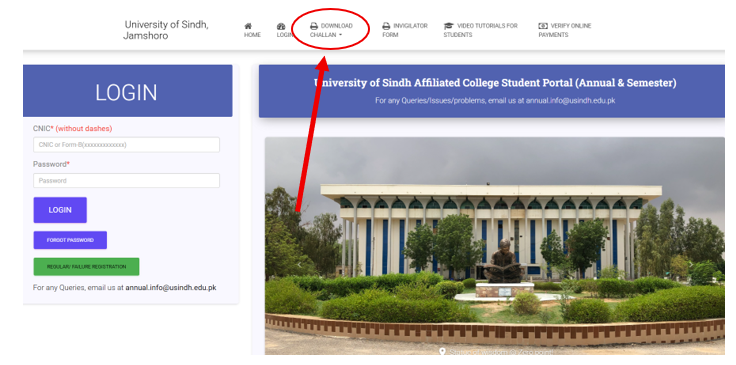
Visit the following portal: https://annaul.usindh.edu.pk/, as shown below.

Figure 7: Snapshot showing the Affiliated Colleges Portal

Click “Download Challan” and choose “Annual Challan” or “Semester Challan.” – For BS programs, choose Semester Challan. – Choose Annual Challan for the following programs: – AD (Arts) – AD (Science) – AD (Commerce) – BA – MA – MSc – MCom – B.Ed (1 Year) – AD (Home Economics)

Tip: All BS programs (e.g., IT, Software Engineering, Chemistry, etc.) are semester-based.

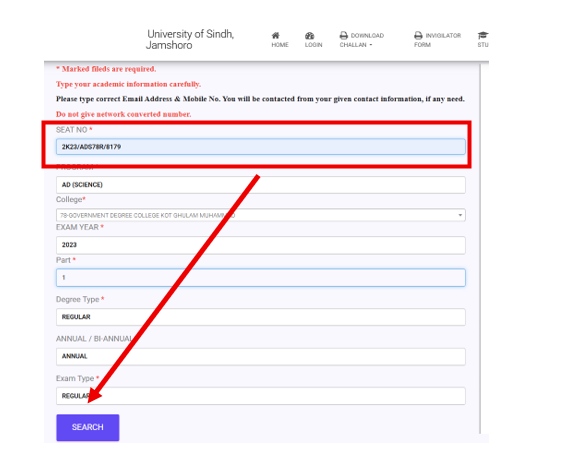
Search the student record by entering the seat/roll number in the Seat No field, as shown below.

Figure 8: Snapshot showing the record search page

Tip: Ensure that you enter the correct seat/roll number, degree program, college name, examination year, and part. This information is available on examination slips or previously issued marksheets.

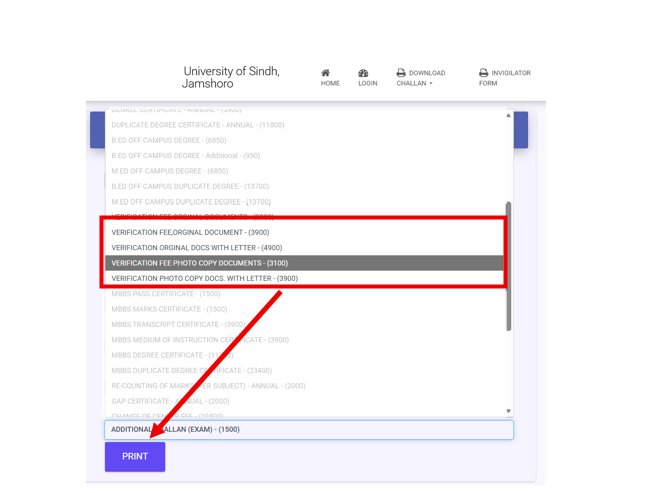
Figure 9: Snapshot showing verification challan options

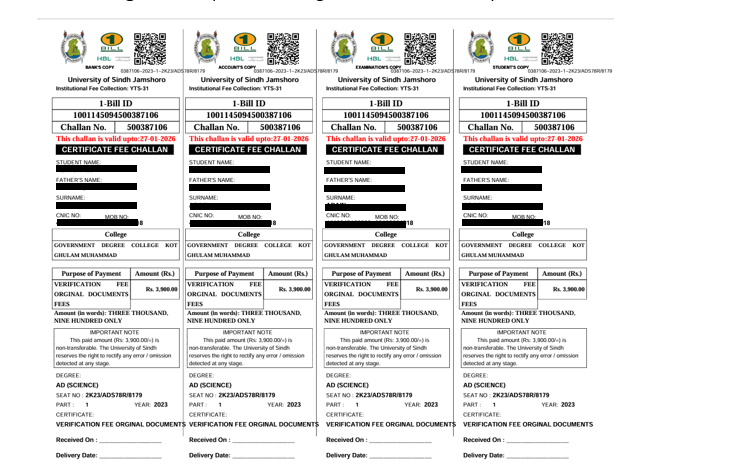
Figure 10: Snapshot showing the verification challan


Types of Verification Challans (Affiliated College Students)

1. Verification (Original Document)
  • Fee: PKR 3,900
  • Used to verify original certificates.
  • Submission and return process is the same as for regular students.
2. Verification (Original Document) with Letter
  • Fee: PKR 4,900
  • Includes verification of the original certificate along with a cover letter.
3. Verification (Photocopy Documents)
  • Fee: PKR 3,100
  • Used to verify photocopies of certificates.
4. Verification (Photocopy Documents) with Letter
  • Fee: PKR 3,900
  • Includes verification of photocopies along with a cover letter addressed to the relevant organization or institution.

Additional Tips: – The university can email verified documents upon request. – Courier service is available at the candidate’s expense. – Sealed envelopes are provided without extra charges. – Verification fees are charged per document.

Our Verification Service

You can also use our services to get your documents verified and have any of your educational documents issued and delivered to your doorstep.

📧 Contact us: info@squid24.com

A-Path-to-a-Healthy-and-Active-Life.jpg
A Path to a Healthy and Active Life

Physical Health Benefits of Running

One of the greatest benefits of running is improved heart health. Regular running strengthens the heart, lowers blood pressure, and improves blood circulation. It reduces the risk of heart disease and helps maintain healthy cholesterol levels.

Running is also highly effective for weight management. It burns a significant number of calories, boosts metabolism, and helps reduce body fat. Along with weight loss, running improves muscle tone, especially in the legs, hips, and core.

In addition, running strengthens bones and joints when done correctly. Weight-bearing activities like running help increase bone density, reducing the risk of osteoporosis. Over time, runners experience improved stamina and endurance, making daily activities easier and less tiring.

Mental Health and Emotional Well-Being

Running is not only beneficial for the body but also for the mind. During running, the body releases endorphins, often referred to as “feel-good hormones.” These hormones help reduce stress, anxiety, and symptoms of depression.

Many people use running as a way to clear their minds and escape daily worries. Morning runs can improve focus and productivity for the entire day, while evening runs help release tension and promote better sleep. Running also builds mental strength, patience, and emotional balance.

Running and Self-Discipline

Regular running teaches discipline and consistency. Setting a daily or weekly running schedule helps develop time management skills and commitment. Runners often learn how to set goals, such as increasing distance or speed, and work steadily to achieve them.

This discipline often extends into other areas of life, including work, studies, and personal development. Running encourages self-confidence and a sense of achievement, which motivates individuals to maintain a healthy lifestyle.

Tips for Beginners

For beginners, it is important to start slowly. A combination of walking and light jogging is recommended at the beginning. Gradually increasing running time and distance helps prevent injuries.

Proper warm-up and stretching before running are essential to protect muscles and joints. Wearing comfortable and supportive running shoes reduces the risk of strain. Staying hydrated and listening to the body’s signals, such as fatigue or pain, are also very important.

Running and Lifestyle Improvement

People who run regularly often become more health-conscious. They pay more attention to their diet, sleep habits, and daily routines. Running encourages a balanced lifestyle by promoting energy, confidence, and a positive mindset.

Running also offers social benefits. Many people join running groups or participate in races, which creates a sense of community and motivation. These interactions make fitness enjoyable and sustainable.

Conclusion

Running is a powerful yet simple exercise that benefits both physical and mental health. It improves heart health, helps manage weight, reduces stress, and builds discipline. Regardless of age or fitness level, running can be adapted to suit individual needs. By making running a regular part of daily life, individuals can achieve a healthier, happier, and more active lifestyle.